

Bullfighting (Corrida) – the Karma of a Living God. Soul Burdens.
As an introduction to this article, see the text titled “Relics of Father Popiełuszko” (Link).
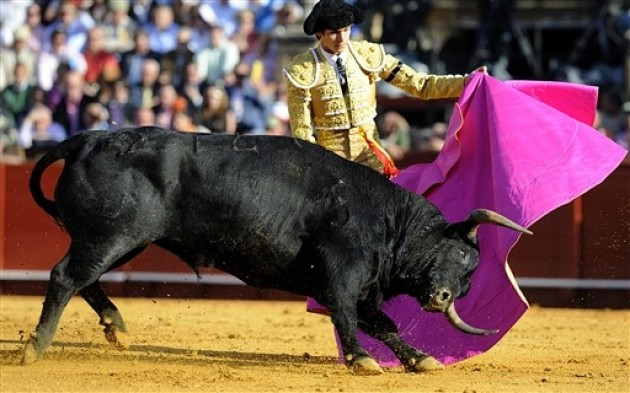
The main theme of several interrelated articles—alongside the destruction of a specially bred and specifically killed Hindu human “deity” called Meria, and alongside the theme of quartering corpses into Holy Sacraments, into various relics—is the corrida, the execution of bulls, in a strangely almost identical way to the cases mentioned above. All three threads therefore need to be seen, analyzed, and understood simultaneously, so that what connects them does not escape the attentive analytical mind.
This text is fully accessible to those who do not insist too strongly and who accept the fact that human Souls incarnate—but who also understand that they do not always incarnate into human bodies (women or men). The fact that someone today wears a dress, or wears a Prada suit, does not mean that a hundred years ago, for example, they were not running through the Amazon forests with hooves and a curled tail.
The ritual of the corrida and the killing of the bull is in no way especially different from the executions practiced by the Maya, the Inca, and the Aztecs. The only difference is that, as most fans think, “it concerns mindless animals, with whom, for healthy emotions, one can have a decent bit of fun before their death.” Spectators, both in ancient times and now, show up at corridas with popcorn and sandwiches. Entertaining themselves without stress in the shaded or scorching parts of the stands, they drink water and wine. The same happened when the still-living body of the Hindu man—here called Meria—was torn into pieces. The same was true at the altars of Crete; the same is true in the 21st century at the corrida. The impact of torment, the pain of the scapegoat, does not change the good mood of the spectators. At most, the murdered victim may be booed—like Roman gladiators—for stubborn, insufficiently spectacular dying.
Just as the Meria people once were, so the bulls for the corrida are specially bred before their death. They have their own kilometers of pasture. They eat their fill of whatever they want—first with their “mom,” and once grown, only with their “friends.” Depending on the culture, some Meria were allowed to have sexual experiences before death. Priests and “holy” people of many religions are forbidden this. Likewise, no heifers are allowed near the bulls, so that they are more “ardent” and, before completing their fifth year of life, show this in the arena.
The bulls, like Meria, are carefully evaluated by veterinarians. They check whether they are healthy and fully fit—whether anything disqualifies them from the final appearances before the public.
The actions of the executioners are divided into time segments so that they maintain full technical capacity. Usually there are a few of them—e.g., 2–3, sometimes more. The same was the case on the Indian pyramids: with mass sacrifices, the priest could grow tired—not to mention an audience bored by an overabundance of the same scenes.
In the afternoon, when most of the arena is already shaded, or at least the heat no longer covers the well-paid boxes, a single spectacular execution of a bull lasts about 20 minutes. After that event, the crew changes, and someone else torments the next bull. The team returns once again, and the whole spectacle lasts about two hours in total.
Today, a ticket to a corrida costs 50–500 euros, and from scalpers up to 1,500 euros, paid to watch the performance of famous matadors.
Initially, several sharp pikes are driven into the bull’s neck (as with Meria), to prepare it. If it does not grasp the seriousness of the situation, an assistant of the executioner drives a dagger into its neck, to encourage the bull to lower its head. Such lowering of the head can, at a stretch, be associated with inspiring the dying to show humility. The task of the main executioner—the matador—is to kill the bull spectacularly with a deft sword thrust. If the matador is poor and stabs without measure, he may be booed, lose his bonus, or not receive the bull’s ear and tail, which he usually cuts off himself from the fallen animal. A merely wounded bull is finished off by the matador with a dagger, which is not well regarded by the audience.
[In history, official city executioners are described as dressed in appropriate red or black garments. There is even a religious–spiritual link between the matador killing the bull and the priest of any idolatrous religion. One can also see a context with religions promoting martyrdom. The matador’s outfit is called the “Suit of Lights.”
I was reminded of a well-known story, supposedly from the town of Biecz, where the city fathers appealed to the councillors of Kraków to lend them an executioner to dispatch several prisoners. The Kraków authorities replied to the people of Biecz refusing, arguing that they had an executioner only for the satisfaction of the residents of their own city.]
In the event someone from the crew is injured, assistance is provided in the local infirmary by the practiced hand of a surgeon. Of course, care applies only to the toreros. The bulls, however—like Meria, or a given saint—go to a different backroom, where butchers waiting strip the victims of their skin, gut them, and portion them. Thus preliminarily prepared, they go to recipients, accordingly:
- Meria—carried by relay runners to nearby villages and placed under the first furrows of the field ploughed in spring.
- A given saint—“As Archbishop Nycz announced, new churches under the patronage of Fr. Popiełuszko may receive them [fragments of the remains]. And the curia will try to meet ‘important requests’ of churches.”
- Bulls—transported by trucks to restaurant cold storage and to meat wholesalers.
The era of consuming the flesh remains of human victims offered “in the name of salvation,” like Meria, or “in the name of the cause,” like Fr. Popiełuszko, has passed. Yet the quartering of the body of a given deity/bull/Meria/saint and dividing it into smaller portions continues to be practiced—justified in every possible way.
Unlike anonymous bulls delivered to restaurants, people murdered spectacularly or cruelly—and their corpses—are, in accordance with the idolatrous procedure, also venerated in the full sense of the word.
Let us look at the saints of various Eastern and Western religions and at what they are venerated for. After all, not for co-creating with God, not for advertising love and the joy of existence. “Holy” people are venerated for how they died. The closer they are to Spartan cruelty, the more vigorous the cult.
Many are venerated because their head was cut off.
Someone is venerated because, like sardines on a wire grill, they were roasted on grates.
Someone was boiled in oil; another was burned alive. These patterns are promoted in many religions as encouragements to life and action.
The more spectacular the torment, the greater the temples built in honor of the figure; the more the faithful pray for support from the dead and for further miracles. And perhaps that is the point—to pull people away from a God full of love and the joy of existence.
For what reason do many people want to watch all this live? One could attempt a preliminary explanation for this demand for public executions—of witches, gods, bulls, criminals, sexual deviants, and more. The cause was given and described across a thousand pages by Sir James George Frazer. His book “The Golden Bough” tries to explain and define what connects almost all idolatrous religions with one another, and also with modern religions of global reach, such as Christianity. It is the torment inflicted by the faithful upon their own gods—upon those to whom they once prayed, and even those to whom they still pray. When reading the book, this phenomenon is strikingly obvious.
Today, the demand for martyrs of a given religion—ancient or still active—is not as wide as it once was. But many Souls still desire to display a particular form of martyrdom, especially if people in the stands, or the direct executioners, regard a specific Soul or its earthly incarnation as a god, a deity, a “holy one,” and pray to it. According to descriptions in “The Golden Bough,” such personalities must/should meet a spectacular, martyr’s death. The 21st century is not a time for human martyrs. Yet it is not so easy to end up on an altar after passing through the hands of a beef butcher or pâté-maker. Still, the fame of a bull/gladiator who did not submit to the torero but was tormented to death is what many Souls want to enter into the records of their glory. This probably also touches the Souls of former butchers, toreros, and priests who, after killing about 5,000 bulls, reappear for a change of mood once again in the arena for another twenty minutes—in a wholly different role and purpose.
In the pattern of the bull ritually killed in the corrida, we can see many related themes concerning the killing of a “deity,” for example in Egypt as Apis. Of course, karma seen this way touches two different personalities of the same Soul, which incarnates into the body of bulls. Another form of karma for the deification of any figure is the karma of a Down syndrome child or an “idiot.” The parents of such disabled children may have been such people in the past, making someone into a deity of any sex. Today they receive a divine hint: “See whom you yourselves created…”
The theme of human sacrifice corresponds, among other things, to the film “The Hunger Games.” It is presented as a young-adult science-fiction novel written by Suzanne Collins.
http://pl.wikipedia.org/wiki/Igrzyska_%C5%9Bmierci
The film, like the book itself, provides viewers with thrills similar to those known to scapegoats, including Meria, and not only to them.
s_majda writes:
15/12/2016 at 23:01
As an aftermath of the recent film about unconsciousness (Link), I worked through the intentions titled “persuasions, suggestions, influences,” which I had previously omitted. I cried evenly through them, and along the way a memory emerged—or rather a fear—that again my body would be eaten as a living god in the ritual once described by Sławek M. In one moment I felt my bond with the ploughed earth (some part of consciousness stayed there), I felt a connection, a linkage with all those who ate a piece of my body, and the necessity and even compulsion to give them everything, including the energies of happiness, prosperity, etc. I am somewhat stunned by this experience.
Please advise what I should do with this. In bowing, I handed over the priest who performed the ritual; I apologized to God for idolatry; I handed over those who convinced me, encouraged me; I handed over unconsciousness. I handed over the threads by which I was bound to those people. Even so, I feel that something still needs to be released—only what? Jola
Log in to reply
s_majda writes:
15/04/2017 at 22:47
Very many Christians still come here—said the sheikh, as if reading my thoughts. These are mainly sick people who want to get well. Last week we had a Christian little girl. She had been sick for many months—she had problems with her head—and nebi Uri came to her in a dream. That’s why she came here and spent the night in the sanctuary. The next day she was healed. Last Friday she returned with a sheep, completely covered with flowers and ribbons, with hooves painted with henna. After the prayers they slit the animal’s throat. Then they cooked it and everyone ate.
“Does something like that happen often?”
“Every week. I speak the words of prayer over the animal, and then the people slaughter it themselves, over there, by the wall.”
“Is it always a sheep?”
“No,” Aluf cut in. “Usually yes, but sometimes they slaughter a young camel, a calf, or a little goat. Whatever it is, it must be a good animal—not a dog—and it must be young and healthy. It absolutely should not be sick or pregnant. Then,” the sheikh continued, “they lead the animal around the tomb three times, pour a little blood onto the tomb of nebi Uri by the door leading into the chamber. They do this to thank nebi Uri for fulfilling wishes. Before they come,” Aluf explained further, “they always promise nebi Uri such-and-such an animal if he does them a favor. So when he does what they wanted, they must keep the promise. We believe that if they give a different animal, or one not so good, or do not come at all, then nebi Uri will punish them.” A fragment of text, p. 215, from the book titled “From the Holy Mountain.”
Log in to reply
s_majda writes:
01/05/2017 at 10:39
For the people of Theodoret’s time, it was important not only to have the presence of living Holy Men, but also to possess their remains, which retained miracle-working power, protected against misfortunes, enemy warriors, earthquakes, raging epidemics. Remembering this will help us understand the battles that were fought not only around the living, but also around the dead ascetics. Link
Opublikowano: 25/12/2025
Autor: Sławomir Majda
Kateogrie: Living gods and lesser deities
Comments