

Medusa Named Gorgon and Cancerous Serpents
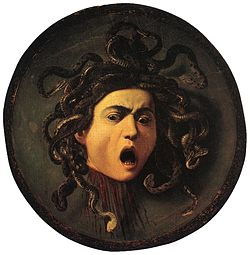
Medusa (Greek: Μέδουσα, Médousa; Latin: Medusa)—in Greek mythology—was the youngest of the three
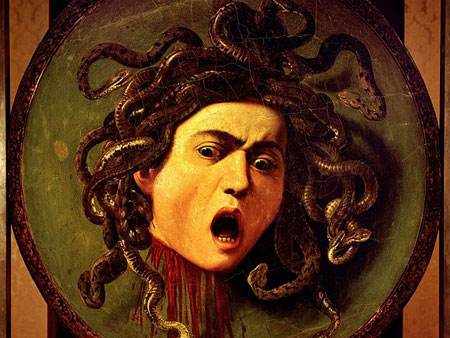
Gorgons and the most dangerous of them (often the name Gorgon is attributed exclusively to Medusa herself). She was the only one of the three Gorgons who was mortal. Instead of hair she had snakes, and her gaze turned living beings into stone. The only remedy for this was the tears of a unicorn. Medusa was killed by Perseus, who cut off her head, and the children imprisoned in her womb—Pegasus and Chrysaor—leapt out from the Gorgon’s neck. Athena then placed Medusa’s head on the aegis, the shield of Zeus.Link
That, in very brief form, is how Greek myths present the story.
Let us now look at this tale through the eyes of a psychologist, a sociologist, and also a contemporary person with clairvoyant insight. Cancerous snakes (astral in nature) are always present in cases of cancer. Regardless of the stage of the disease or its location, snakes are a constant element that can be seen immediately.
Let us consider what the presence of snakes on the head instead of hair might signify. Does this not bring to mind cancers of the head, cancers of the brain—such as gliomas, for example? Or cancer of one of the two endocrine glands located in the head? One can choose freely among the possibilities.
Living astral snakes on the head can indeed produce an image similar to the one depicted in the aforementioned representations. Only a stubborn person would insist that in Hellas there were no clairvoyants and no people suffering from cancer. Thus, cases of brain cancer could very well have existed there. Perseus may therefore have seen this in some clairvoyant vision.
Let us now consider the matter psychologically. Did he help a woman suffering from cancer? No—he cut off her head, citing illness and suffering. Can we therefore infer psychopathic traits or karmic burdens in him?
And the matter of placing that head on a shield is itself an interesting technical and psychological curiosity. If those four deities truly once walked the Earth, then parading around with a dead woman’s head as an added burden on a shield would hardly have been practical. Shields served defensive purposes, and one must have considerable strength to fight with one hand while shielding oneself with the other, bearing a shield whose own weight is already burdensome, even without additional attachments. Moreover, carrying such additions for any length of time would have been highly unhygienic for obvious reasons.
Yet Zeus is described as a zoophile, a deviant, and a psychopath, so perhaps he did indeed have a taste for such behavior. Still, it may be assumed that for practical reasons the head on the shield was merely a hologram—perhaps a warning Zeus directed at potential adversaries:
“Look—Medusa. This is yet another, the thousandth victim of Zeus and his Soul. She has brain cancer. If you do not wish to share her fate, stay away from him and those like him.”
Other astral snakes worn by people and Souls on their heads are green in color and therefore theoretically non-cancerous. The green hue comes from a laurel wreath that masks them. These leaves—crafted by artisans, often from gold—were also worn by many “divine rulers,” not only Roman ones. Thus, snakes could also appear on heads in a similar golden coloration.
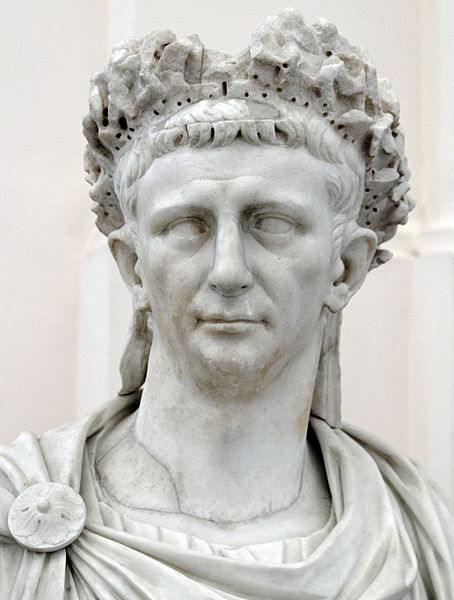
Because God is literal, when asking for release from cancerous snakes it is worth mentioning and enumerating all other known and unknown types as well—their ranks, sizes, genders, and locations. For example: general, imperial, cosmic snakes and worms, and so forth.
Opublikowano: 16/01/2026
Autor: Sławomir Majda
Kateogrie: Cancer, cancer recovery. Astral snakes.
Comments