

The Holy Trinity. Intentions for Prayer Work
Compiled by Agata Pająk
Abbreviations: MS – my Soul
GGL – God, Giver of Life
PSEBC – people, Souls, entities, beings, creations
Intentions concerning, among others, the Trinity
- our own, and through us and other people’s, from all causes and by all means, including being, among others, Christians, Catholics, Orthodox Christians, Lutherans, Anglicans, Calvinists, Methodists, Presbyterians and not only these, as well as being like them, being as they are and believing as they do in, among others, the Holy Trinity, in, among others, the Christian dogma stating that God is, among others, a Triune God, existing as three Persons [worthy of worship and deification], while at the same time remaining one being, as well as our own and other people’s professing faith in this dogma and treating and promoting it as a central truth of faith in Christian theology, similarly to drinking the blood of Jesus and not only this, as well as our own and other people’s experiencing of all the consequences of this
- our own and other people’s being convinced, believing, teaching others and being taught that, among others, the Holy Trinity, the three Persons [worthy of worship and deification], are understood as possessing the same single essence, that is, nature, and not merely similar natures, and not only this, as well as our own and other people’s experiencing of all the consequences of this
- our own and other people’s explaining, interpreting and justifying to ourselves and others, for the purpose of understanding, confusing and not only these, that, among others, the Holy Trinity is one God existing simultaneously in three Persons [worthy of worship and deification] and in one substance, the Father, the Son and the Holy Spirit, and not only these, as well as our own and other people’s experiencing of all the consequences of this
- our own and other people’s believing, being convinced, teaching and being taught about the dogma concerning the Holy Trinity, which was ultimately approved at the Council of Constantinople in the year 381, although already at the Council of Nicaea in the year 325 the consubstantiality of the Father and the Son was officially recognised, which constitutes the foundation of the dogma, meaning a thesis presented as truth, among others, by the Catholic Church, by Christians and various heretics [idolaters], as well as our own and other people’s recognising faith in the Holy Trinity as the first necessary condition for joining the World Council of Churches, and not only this, as well as our own and other people’s experiencing of all the consequences of this
A medieval illustration depicting the Holy Trinity
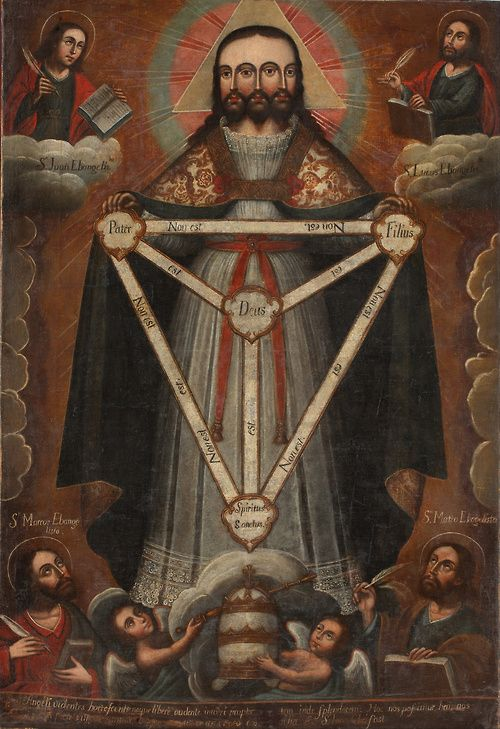
- our own and other people’s contributing significantly to introducing the dogma of the Holy Trinity into Catholic, Christian and not only these religions, and thereby leading directly to God Himself, to Enlightenment through Divine Love and correspondingly to idolatry, to causing other beings, PSEBC, instead of believing in the One God, to begin believing in the Holy Trinity, as well as creating this dogma, constructing an ideology around it and not only these, as well as our own and other people’s experiencing of all the consequences of this
- our own and other people’s being various priests, creators and Christian writers who recognised, wrote, encoded and created certain passages of the Old Testament as a record of God’s revelation containing a vague foretelling of the mystery of the Holy Trinity, and not only this, as well as our own and other people’s experiencing of all the consequences of this
- our own and other people’s considering that testimonies concerning the revelation of the mystery of the Holy Trinity are found in the genius, mind and letters of Saint Paul, especially in the passage: “The grace of the Lord Jesus Christ, the love of God and the gift of the unity of the Holy Spirit be with you all,” and not only this, as well as our own and other people’s experiencing of all the consequences of this
- our own and other people’s allowing ourselves to claim, on the basis of Saint Paul’s words of blessing, and especially because the individual subjects of the sentence occur in the genitive case: “of the Lord Jesus… of God… of the Holy Spirit,” that each of the Persons mentioned is separate, yet they are also equal to one another because the graces mentioned flow from one Deity, and not only this, as well as our own and other people’s experiencing of all the consequences of this
- our own and other people’s convincing others that the revelation of the Holy Trinity is also contained in passages of the Gospels describing the relationship between the Father and the Son, while the baptismal formula constitutes a direct statement referring to the Trinity, and not only this, as well as our own and other people’s experiencing of all the consequences of this
- our own and other people’s, including as various theologians, priests, bishops, high priests, their equivalents and substitutes, bearing witness to the Father, the Son and the Holy Spirit by mentioning them together, and not only this, as well as our own and other people’s experiencing of all the consequences of this
- our own and other people’s calling PSEBC, including Christians, to become incarnated within the Divine temple, so that through union with Christ, in the Spirit, they may become sons of the Father, as well as emphasising the insufficiency of human language for describing the mystery of the Deity, teaching this and emphasising the co-eternity of the Word with the Father, and not only these, as well as our own and other people’s experiencing of all the consequences of this
- our own and other people’s using the term Trinity, yet departing from the concept of one God in three Persons simultaneously and without a clear reference to the Holy Trinity understood in personal terms, and not only this, as well as our own and other people’s experiencing of all the consequences of this
- our own and other people’s believing, teaching and also using in the Nicene Creed the statement that the three-personal, Triune God reveals Himself to the human being as the Father, the Son and the Holy Spirit, yet each of these Persons is the same one God, and that this God is almighty, eternal and infinite, and that the individual Persons [worthy of worship and deification] are identical in nature and substance, meaning that they are one and the same God, yet they are separate Persons, hypostases, differing in origin and mutual relationships, possessing, as it were, their own consciousnesses and minds, and not only these, as well as our own and other people’s experiencing of all the consequences of this
- our own and other people’s, as Christians, Catholics and not only these, as well as like them, believing and teaching others that God the Father proceeds from no one, that the Son of God was begotten and not created by the Father, that the Holy Spirit proceeds from the Father and the Son, or only from the Father through the Son, and that the Father is not the Son, the Father is not the Holy Spirit, the Son is not the Holy Spirit and is not the Father, the Holy Spirit is neither the Father nor the Son, while the Father, the Son and the Holy Spirit are God, and not only these, as well as our own and other people’s experiencing of all the consequences of this
- our own and other people’s recognising as the fundamental source for the teaching about the Holy Trinity the words of Jesus from the Gospels, where Jesus describes Himself as the Son of God remaining in unity with the Father and promises the Apostles that the Holy Spirit will be sent to them, and not only this, as well as our own and other people’s experiencing of all the consequences of this
- our own and other people’s carrying out, and commissioning others to carry out, the final command given by Jesus to His disciples, which according to the Gospel of Matthew 28:19 read: “Go therefore and teach all nations, baptising them in the name of the Father and of the Son and of the Holy Spirit,” and not only this, as well as our own and other people’s experiencing of all the consequences of this
- our own and other people’s treating the teaching about the Holy Trinity as a dogmatic formulation of the revelation made by Jesus of Nazareth in the New Testament, developed over the centuries by Christian theology, and not only this, as well as our own and other people’s experiencing of all the consequences of this
- our own and other people’s being aware that in the Old Testament God essentially reveals Himself as one Person, which stands in contradiction to the teachings of Jesus, Paul and priests, and to our own and their understanding of truth and understanding of God, and not only these, as well as our own and other people’s experiencing of all the consequences of this
- our own and other people’s searching in the Old Testament for glimpses of the New Testament revelation of the Holy Trinity, namely in the first account of creation, where God says “Let us make,” or in the visit of three figures to Abraham, and not only these, as well as our own and other people’s experiencing of all the consequences of this
- our own and other people’s regarding the Triune God existing as three Persons [worthy of worship and deification] as a mystery impenetrable to the human mind, while nevertheless making attempts to justify it, including as various kinds of theologians and not only these, as well as our own and other people’s experiencing of all the consequences of this
- our own and other people’s being convinced, believing, teaching this and convincing ourselves and others that for God, as infinitely perfect, the existence of other beings apart from Himself is not necessary, yet at the same time He possesses love in an infinitely perfect degree, and since this is so, it cannot be egoism, from which it follows that God exists in at least two [or more] Persons simultaneously, while each Person may make an infinitely perfect gift of Love to the other by giving the fullness of Himself, and the other Person is fully capable of receiving such a gift because neither of these Persons ceases to exist as a result of this giving, since that would contradict the Love of the receiving Person [worthy of worship and deification] toward the giving Person [worthy of worship and deification], and from this emerges the necessity for the existence of a third Person [worthy of worship and deification], who, because of the nature of this act, is the subject of the mutual giving between the other two, while the existence of a greater number of Persons is not necessary, and since God is infinitely perfect, there is also nothing superfluous within Him, and not only these, as well as our own and other people’s experiencing of all the consequences of this
Technical matters concerning the idea and the construction of sentences when working with intentions
Article “800 Intentions for Cleansing” Link
“Constructing Extensive Intentions and Prayers. A Skype Conversation About the Technique” Link
“One-Sentence Pattern for Working with Intentions” Link
The word (–not) added to a word when working with intentions means that it is worthwhile to mention it together with its opposite, or even, during the work itself, independently find and speak any synonyms that come to mind together with their opposites.
For example—being poor, sick; it is good also to say it together with its opposite
–being poor, sick, –not being poor, sick
This makes it possible immediately to address a given pattern as broadly as possible in different aspects, including its opposite. It is also worth knowing that Souls often think and claim that they do not have such opposite patterns, for example that they are not idolaters in a given case or with a given word.
Another example:
The Soul of a woman denies ever having been a bad mother. Therefore, adding the negation—not being a bad mother—may allow her to understand the state in which she finds herself.
Being a bad mother, –not being a bad mother–
“Absolutely not, never in my life! These are not my patterns. What I am doing is my private matter.” [This is what the Soul very often says or thinks about itself.]
This post has 2 comments
- s_majda says:12/04/2016 at 13:24
- our own and other people’s being convinced, believing, convincing others and being convinced by others that we cannot comprehend or understand the mystery of the Holy Trinity, the knowledge of the Triune God existing as three Persons [worthy of worship and deification], that we are incapable of doing so, and not only this, as well as our own and other people’s experiencing of all the consequences of thisour own and other people’s being defenders of the doctrine of the Holy Trinity, the knowledge of the Triune God existing as three Persons [worthy of worship and deification], demonstrating and convincing everyone and ourselves that God is one in three Persons simultaneously, although this transcends reason and earthly laws of logic and reaches depths of the mind inaccessible to us, and not only this, as well as our own and other people’s experiencing of all the consequences of thisour own and other people’s bearing witness to the monotheism of the Christian doctrine of the Holy Trinity and proving and explaining to others that the Holy Trinity is not many gods, and not only this, as well as our own and other people’s experiencing of all the consequences of thisour own and other people’s bearing very strong witness to the monotheism of the Christian doctrine of the Holy Trinity, to the knowledge of the Triune God existing as three Persons [worthy of worship and deification], believing in such testimony, promoting it and teaching about it after Saint Augustine, who stated: “And because man was created in the image of the Trinity, it is therefore said: ‘in our image and likeness.’ Yet afterwards, lest anyone should think that we are to believe in three gods, since the Trinity is one God, Holy Scripture says: ‘And God created man in the image… of God’ (Genesis 1:26–27), which means: ‘in His own image,’” and not only this, as well as our own and other people’s experiencing of all the consequences of thisour own and other people’s presenting various arguments, objections and difficulties against recognising the entire Holy Trinity as one God because the dogma was formulated only at the end of the fourth century after the birth of Jesus, and also because among the Apostolic Fathers nothing is found that would resemble the concept of the Trinity even to the slightest degree, as well as our own and other people’s doubting the dogma, fearing to doubt it, opposing it, accepting it and not only these, as well as our own and other people’s experiencing of all the consequences of thisour demanding from God that reason manifest itself in priests, people and Soulsour own and other people’s, following the works of Christian dogmatic theology, considering and being convinced, as well as showing ourselves and others, that in Bethlehem God assumed human form and was born as Jesus Christ, the Messiah—the Anointed One—for the purpose of saving humanity, and that God’s revelation to the human being took place in Jesus as the second Person of the Trinity—the Son of God, or the Word, Logos—and that the entire indivisible Trinity is involved in this, as well as that in the Incarnation the two remaining Persons [worthy of worship and deification], the Father and the Holy Spirit, sharing the Divine nature with the Son-Logos, were united with human nature by virtue of the union constituting Him as the Divine-human Person of Jesus, meaning that Jesus of Nazareth is both true God, consubstantial with the Father and the Spirit, and true man—He has two natures but is one Person, the Second Person of the Trinity—and not only these, as well as our own and other people’s experiencing of all the consequences of thisour own and other people’s celebrating various feasts of the birth of a god, the birth of a Divine Mother, and the feast of, among others, the Holy Trinity, proclaimed in various Protestant and Catholic churches, including on the first Sunday after the Descent of the Holy Spirit, meaning 56 days after Easter, or in churches of the Eastern rites, in Orthodoxy or the Greek Catholic Church, on the 49th day, as among the most solemn Holy Masses of the year, as well as decorating Orthodox churches, churches and not only these with freshly cut grass, adorning them with birch branches, and on the following day, Monday, celebrating the Day of the Holy Spirit, including with ceremonial feasts and not only these, as well as our own and other people’s experiencing of all the consequences of thisour own and other people’s believing and being convinced that the Trinity does not exist because there is no mention of it in the Bible, including as Jehovah’s Witnesses, Arians, Bible Students, Unitarians, the Polish Brethren or followers of the Church of Christians of the Sabbath Day and not only these, being as they are, and that there is no such revelation in the texts of the Old and New Testaments, and not only these, as well as our own and other people’s experiencing of all the consequences of thisour own and other people’s recognising Christ as equal to the Father, to God, regarding this as normal, exaggerating His Divinity, granting Him Divinity, while diminishing His significance as Saviour or Messiah, and not only these, as well as our own and other people’s experiencing of all the consequences of this
- Reply
- s_majda says:16/01/2022 at 12:23“Trinity” is a female given name in the USA. Well…
Opublikowano: 30/08/2026
Autor: Sławomir Majda
Kateogrie: Religions, priests, sects, idolatry, vows.
Comments